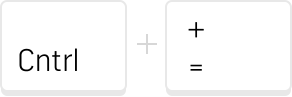
 To increase or decrease the font size of text, use the following keyboard shortcuts:
Windows
Apple
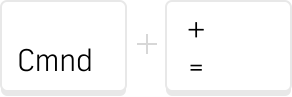
To increase or decrease the font size of text, use the following keyboard shortcuts:

Toward the end of 2026, some eID cards issued to residents will see changes in the use of the secure electronic signature embedded in the card. This is related to the certification of the microchips in eID cards in accordance with European Union requirements. According to the current assessment, the use of qualified electronic signatures on some eID cards will be provided until December 9, 2026. Currently, Latvia State Radio and Television Center (hereinafter – LVRTC), in cooperation with OCMA and MoSARD, is working on several solutions to ensure that holders of these eID cards can continue to use them for electronic document signing.
The changes may affect:
The affected eID cards were issued as:
According to information available to the LVRTC, after December 9, 2026, the changes may affect more than 346,000 eID cards containing the Cosmo 8.1 microchip version.
Why is certification important for qualified electronic signature creation devices?
eID cards contain a built-in chip (data carrier) that stores electronic signature and authentication certificates. These chips may have different software versions. If the chip, along with the software it contains, is certified as a qualified electronic signature creation device (QSCD), qualified electronic signature certificates can be included on the eID card.
Some of the eID cards issued during the mentioned period use the Cosmo 8.1 chip version, whose QSCD accreditation may expire after December 9, 2026. In that case, these chips may lose their QSCD status. This means that LVRTC will no longer be permitted to provide qualified electronic signatures using these eID cards, and all existing qualified electronic signature certificates issued on these eID cards will have to be revoked.
How can I check whether my eID card will be affected by the changes?
Holders of any eID card issued between September 2, 2019, and January 30, 2026, can check the version of the microchip embedded in their eID card themselves by visiting https://reg.eparaksts.lv/eidinfo using any of the available authentication methods. Holders of affected eID cards will receive information from LVRTC regarding the impact on the electronic signature certificate embedded in the eID card.
Please note! LVRTC will not be able to notify eID cardholders who have provided an email address that is included in the National List of Restricted Media Domains (e.g., the .ru domain, so emails are not sent to these domains).
Possible solutions for ensuring eSignature functionality after December 9, 2026
Currently, the QSCD accreditation certificate for the eID card microchip is valid until December 9, 2026. Until then, both technological and legal solutions are being evaluated to ensure that users of affected eID cards can continue to use electronic signatures.
The primary focus is on implementing a technical solution that would allow users to continue creating fully compliant electronic signatures with the affected eID cards. If this solution can be implemented by December 9, 2026, residents will be able to continue using the affected eID cards to sign electronic documents.
However, if it is not possible to implement the said technical solution by the set deadline, an alternative solution will be considered—providing that, in certain cases in Latvia, documents signed with an enhanced electronic signature, which can be created using the affected eID cards, will also be recognized. Such a solution would require corresponding amendments to the regulatory framework and would apply to document circulation at the national level.
What should eID card holders who may be affected by these changes do?
To find out the version of your eID card’s microchip, we encourage you to visit https://reg.eparaksts.lv/eidinfo now.
To receive timely updates regarding the status of the electronic signature certificate included in your eID card, we encourage you to verify the accuracy of the contact information provided when you received your eID card or to update it using the e-service “Changing Contact Information for PMLP Identity Document Notifications” on the Latvija.gov.lv portal: https://latvija.gov.lv/Services/39162. LVRTC will send notifications and instructions regarding necessary actions to the contact information provided.
The eID card remains valid for identity verification in person and for travel, and there is no need to replace it.
We encourage eID card holders to install the eParaksts mobile app on their smartphones as well, if possible. Find out how to get the eParaksts mobile app https://www.eparaksts.lv/en/Produkti/Privatpersonam/mid/apraksts